|
The Viking Age runic alphabet, known as the futhark, were used from Greenland in the west to Russia in the east. The runic inscriptions are the oldest preserved original documents and are an important link to ancient times. Although runes were initially found throughout the Germanic language area, it was in Scandinavia that they spread the widest and were used for the longest time. During the period from around 500–700AD, the Scandinavian language changed dramatically, which also created a need for modifying the writing system. In the early 700’s, a new runic alphabet was created with only 16 different characters, replacing the older one. Since the new runic alphabet began to be used at around the same time throughout Scandinavia, a lot of people have suggested that it must have been the result of a deliberate writing reform, perhaps created by traders. The Rök stone is Sweden's most famous rune stone. It’s also the longest runic inscription in existence. The text consists of 800 symbols. The stone stands outside the church in Rök and it’s believed that the place was named after the stone.
(Source: Swedish National Heritage Board)
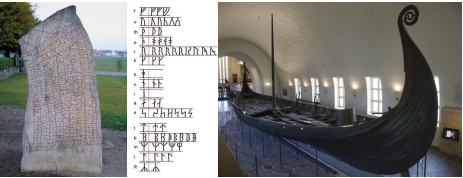
The Oseberg ship from the Viking Age was found in 1903 in a large burial mound at Oseberg farm In Vestfold shire, just north of Tønsberg on the western shore of the Oslo fjord. The ship, which is 21.5 m long and 5.1 m wide, is very well preserved. The incredibly rich, decorative wood carvings indicate that the ship had a very particular function Dendro-dating of wood from the burial mound has shown that the ship was built in 820 AD and the grave was sealed in 834 AD. Two women, one young and one old, were buried in a house constructed on the deck and they were buried with a large number of wonderful objects. The burial gifts consist of, among other things, a beautifully carved four-wheeled cart, two oxen, fourteen horses, four dogs on an iron leash, four sledges, three beds, kitchen utensils, weaving equipment and a wide variety of textiles. Walnuts, wheat and wild apples were also found among the burial gifts. It’s believed that the younger of the two women, whose remains have been better preserved, is Queen Åsa Haraldsdotter, Gudröd Veidekonung's grandmother, mother of Halvdan the Black and grandmother of Harald Hårfager.
Åse Öjbro, the designer and founder of Öjbro Mitten Factory, has created wearable art with mittens as the starting point. Åse also worked as an artist, making paintings for many years before deciding to express herself in wool. She created this pattern design, drawing inspiration from the great importance of our cultural heritage. She’s created this illustrative pattern with the runic inscription "We honour our cultural heritage" with the Futhark, thanks to the help of the National Heritage Board.
I love our Scandinavian cultural heritage. Most of us can find a namesake in the Viking Age and I’m lucky enough to be called Åse, with my namesake being Åsa Haraldsdotter, a legendary queen and the grandmother of Harald Hårfager. It creates perspective and a feeling of belonging here in Scandinavia. I wanted to use runic script and to carve my rune into a pattern, saying ‘we honour our cultural heritage’. The concept of cultural heritage is my way of bringing history into the present.
|
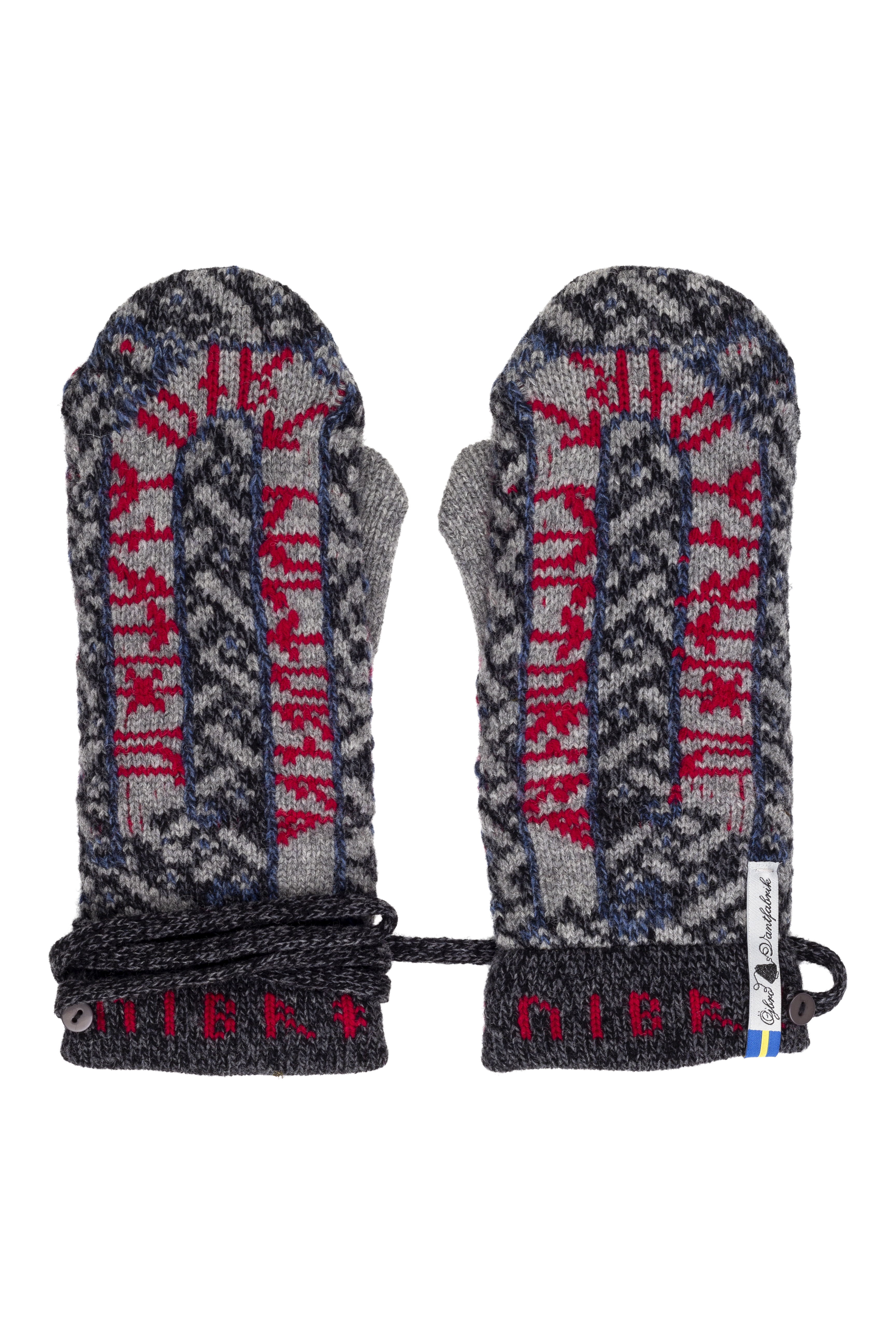
We don’t know how long
mittens have been knitted in
Scandinavia, but
fragments of mittens have
been preserved from as far
back as the 13th century.
* This mitten is inspired by
our cultural heritage, and
with the help of the futhark
we’ve created our runic
inscription ‘we honour our
cultural heritage’ which
we then made into a
pattern with a classical
colour scheme.
Öjbro Mitten Factory is
passionate about keeping
our various knitting
traditions alive |